Watering Eyes in adults
Do your eyes water? Do tears run down your face, or do they drip onto your glasses?
Tearing eyes, running eyes, sticky eyes, blurred vision, eyes stuck together in the morning, tears dripping down your face, or onto your glasses, particularly on a cold or windy day, people thinking you’re upset or crying? Unable to watch the television, read the paper, drive safely or play golf because one or both of your eyes keeps filling with tears? Or maybe you think you keep getting eye infections - conjunctivitis - with your eyes stuck together in the morning, or crusting? And despite using eye drops things are no better - even getting worse?
It’s a common problem, it’s not very pleasant, and it may well be due to a blocked tear duct.
What happens when tear ducts are blocked?
 To remain healthy the eyes must be kept moist with tears, and whenever you blink the eyeball is gently cleaned – like the passage of a windscreen wiper – and tears are spread over the surface.
But these tears need to drain away down a special tube into the nose - the tear duct - which is why when we cry we often find we have a runny nose too.
This tear duct can easily become blocked.
When this happens the eye fills up with tears and often gets sticky. Tears that spill over the face become crusty when they dry up and may look just like conjunctivitis. Untreated blockages of the tear ducts not only cause teary eyes but can lead to an infection of the blocked duct or even the eye – which is very unpleasant and can be serious.
What causes blocked tear ducts?
There are many reasons for this to happen. Sometimes the tear ducts are narrow from birth, sometimes a narrowing in part of the tear duct occurs later for example after infection or an injury. Blockage can occur anywhere from the eye to deep within the nose where the duct should open out and can affect one eye or both eyes.
There are many reasons why eyes may water apart from blockage of the tear ducts. Sometimes too many tears are being produced due to irritation of the surface of the eye. Problems with the eyelids can also lead to watering such as when the lid becomes saggy or even hangs out away from the eye (known as an ectropion).
What can be done about these problems? Will I need an operation?
Any eye problem needs to be assessed by an expert to identify the underlying cause and treat it. When you telephone my secretary she will arrange a private consultation with me personally at a date and time convenient for you – usually within a few days of your call.
I will see you personally where we will go through your symptoms before I fully examine your eyes using state-of-the art equipment.
I aim to give you a diagnosis that day and I will explain all the treatment options for your condition. Understandably you would want to avoid an operation if at all possible but occasionally surgery is the best or only treatment recommended. You can be assured that I will perform a thorough assessment of your eyes and general health and recommend a treatment tailored to your specific needs. And if you do need an operation we will make the arrangements once again for a day that suits you.
What are the best treatments for blocked tear ducts?
Blocked tear ducts don’t improve by themselves. Surgery is usually the best solution. The procedure will depend on where the blockage is. Sometimes the entrances to the tear ducts need to be opened with a minor procedure. Sometimes a DCR operation - a keyhole operation usually carried out through the nose - is required. Other procedures may be needed depending on the type of blockage to ensure the tears can drain away.
What can I expect after surgery?
Recovery after surgery is usually rapid. The eyelids may be swollen and bruised and a little sore after surgery but this quickly settles and can be helped by ice packs and simple painkillers like Paracetamol and Ibuprofen. You may have an eye pad to wear for the first night too to help protect the eye and keep you comfortable. This can come off the following morning.
After your operation you will be given antibiotic eye drops which will also help things settle. A week off work is a good idea whilst things settle down, and you should also avoid swimming and heavy exercise for the first 2-3 weeks.
It may take a week or more after surgery before the tearing starts to improve as the tears start to drain away into the nose as should normally happen.
What sort of follow-up will I need after surgery?
I always arrange to see you after the operation to make sure things are improving as expected, followed by further review appointments as required.
You will be given a number to contact in case of problems and can be reassured that I am always available between appointments - in case of any concerns simply contact my secretary and I will try to call you right back - and if necessary see you again quickly.
Who am I? And why should you trust your eye health to me?
My name is Andrew Pearson and I am a Consultant Eye Surgeon - my NHS practice is based at the Royal Berkshire Hospital, Reading and the Prince Charles Eye Unit, Windsor.
I always see private patients personally and at your convenience – usually within the week.
I have undertaken specialist oculoplastic eye surgery training in Nottingham and Moorfields Eye Hosiptal, London. I am also a founder member of the British Oculoplastic Surgeons Society – in other words I not only treat patients, I am involved in training eye surgeons of the future.
My research interests span many years and I regularly present studies at national and international meetings on eye conditions.
What do other patients say?
I would like to express my sincere thanks and gratitude for 'fixing' my eye. Your skill in unblocking my watery eye is like 'the miracle worker'.
On the rare occasions in my life when I have experienced absolute excellence I have been at a complete loss for words. This is the case now. So, all that I can write to you is ‘Thank-you’.
Just wanted to thank-you for the fact that my minor operation to the lower eyelid has yielded such a splendid result and I no longer have constant weeping from my left eye. I am profoundly grateful that more than two years of irritation has now ended.
How do I make an appointment?
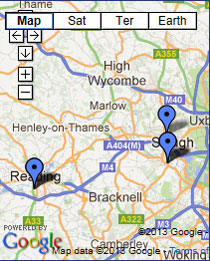
I see patients privately at:
Circle Hospital, Reading
100 Drake Way
Reading
RG2 0NE
The Princess Margaret Hospital, Windsor
Osborne Road
Windsor
Berkshire SL4 3SJ
Spire Thames Valley Hospital
Wexham Street
Slough
SL3 6NH
To arrange an expert assessment of your eyes simply contact my secretary Susanna Morys:
Tel: 01753 841567
Email: Click here to email
Your eye health is extremely important – don’t delay, make an appointment TODAY.
Click here for map locations of the hospitals above

 Font Size: